Argentina’s digital media outlets have spent two years experimenting with AI in their newsrooms*. What they’ve learned about what to delegate — and what not to — is a roadmap any communications team can use.
When Infobae describes AI as its “editorial partner” and La Nación calls it an “assistant,” it’s not just a naming difference. It’s a difference in philosophy about how much power you give the tool and how much you keep for yourself.
For my research, I mapped in detail which tasks journalists at Argentina’s three leading digital outlets assign to AI and which they refuse to delegate. That map is one of the most useful things I can share with anyone looking to design their own hybrid workflow.
Tasks worth delegating
The most established and celebrated uses in newsrooms are what journalists call “low value-added tasks”: transcribing interviews, summarizing lengthy documents, assembling articles from wire agency cables, grammar and spell-checking, optimizing headlines for SEO, and tagging content for navigation apps.
The logic is clear: these are tasks that consume time without requiring the journalist’s differentiating judgment. Delegating them frees up hours to do what genuinely matters. “When I started, I’d get a pile of wire cables and had to turn three of them into a single article. Now an intern can be learning something more meaningful,” described one Infobae editor.
AI also has value as a creative stimulus: to unblock ideas on a given topic, explore possible angles, generate headline variations when you’re stuck. As a starting point, not a destination.
Tasks not worth delegating
The limit that every journalist I interviewed drew most firmly was editorial judgment. Deciding what’s news, what angle a story has, how to contextualize it, which sources to consult, how to prioritize information — none of that gets delegated.
Verification doesn’t get delegated either. “You need human oversight at the end of the production line, and even in the middle, depending on the nature of the piece,” explained one Infobae reporter. AI makes mistakes — journalists call them “hallucinations” — and it has no internal mechanism to recognize them. Publishing without checking means taking that risk in front of your audience.
And above all, voice doesn’t get delegated. The tone, style, and perspective that makes content recognizably yours — or your organization’s — is precisely what algorithmic homogenization threatens.
How to design the wWorkflow
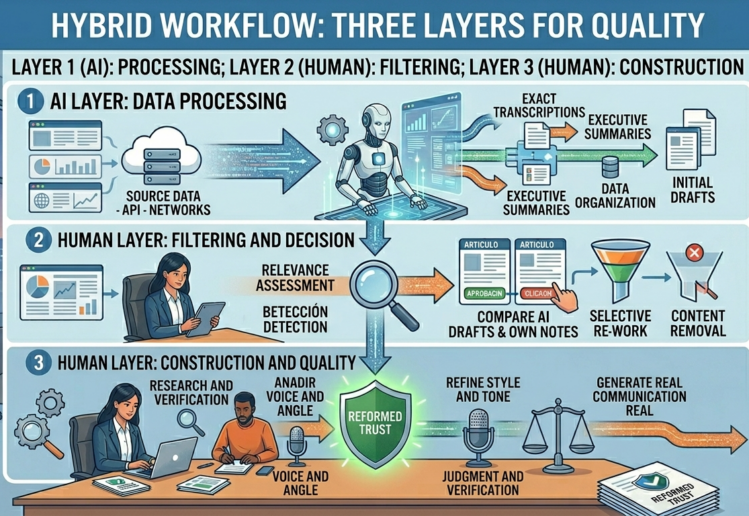
The model that emerges from the newsrooms studied has three layers.
First, AI processes information: it transcribes, summarizes, organizes data, generates drafts.
Second, the human filters and decides: what from the draft is usable, what needs reworking, what gets cut.
Third, the human builds: adding the judgment, the verification, the voice, the angle that transforms raw material into real communication.
The key isn’t how much you use AI, but which layer you put it in. Use it in the first layer and you gain time. Use it in the third and you lose identity.
*Post based on the author’s 2026 master’s thesis: “Between the Human and the Automatic: Generative AI and the Role of Journalism as a Cultural Mediator.”
*Image credit: Created with Nano Banana.