When media outlets use the same AI models to produce content, the result tends to sound alike. What was once differentiation is becoming algorithmic convergence — and brands are no exception.
During my research on the use of generative AI in Argentina’s leading digital media from 2023 to 2025, one of the most unsettling findings had nothing to do with job replacement or disinformation. It was about something quieter: the homogenization of content.
A deputy editor at Clarín put it plainly: “If we go all in and think we can replace the newsroom with AI agents, we’re going to have a serious quality problem.” His concern wasn’t about losing his job — it was about losing identity. “If we all end up writing the same thing, what distinguishes us?”
The problem with shared models
Generative language models are trained on pre-existing data. That means the more outlets and brands use the same models to produce content — and the more that content feeds back into training data — the more the information and communication ecosystem will tend toward convergence.
It’s not that everyone will publish exactly the same thing. But they will sound similar. They’ll tend toward the same angles, the same structures, the same tones. The diversity of voices — one of the most important values in journalism and quality communication — will narrow.
A journalist at Infobae illustrated this with a concrete example: when asking an AI model for images of actor Denzel Washington, it returned generic photos of Black men. The bias wasn’t malicious; it was structural — it reflects dominant patterns in the training data. The same thing happens with text.
The total SEO trap
There’s another factor that compounds the problem: search engine optimization. If a brand — or a media outlet — produces content exclusively designed to rank on Google and uses AI to scale that content, the result is a universe of technically correct and profoundly unremarkable texts.
“If media produce only large volumes of content for search engines and AI tools, they all end up writing the same thing, losing the unique identity and quality of each outlet,” warned a journalist at Clarín. The same risk applies to any organization that confuses volume with value.
Differentiation as a survival strategy
The journalists I interviewed reached a unanimous conclusion: survival depends on differentiation. Quality journalism — authored, with a distinct voice and a perspective that’s hard to replicate — is what can compete in an ecosystem flooded with automated content.
For brands and organizations, the logic is the same. In a world where anyone can generate acceptable text in seconds, content that genuinely connects is content that has its own perspective, a recognizable voice, and something real to say.
How to build a distinct voice in the age of automated content
First, document what only you know: your own data, your cases, your first-hand experience.
Second, invest in your point of view: AI can write about any topic, but it can’t have your specific perspective on it.
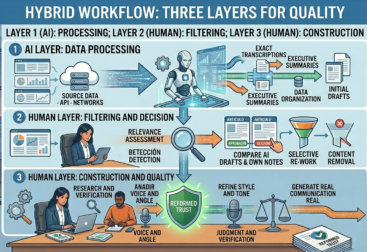
Third, curate with judgment: not everything a model produces is worth publishing. The human filter is what turns output into content.
*Image credit: Created with Nano Banana.