When anyone can generate text with a single click, what sets you apart isn’t speed. It’s what no algorithm can replicate.
Since tools like ChatGPT, Copilot, Claude, and Gemini entered newsrooms and organizations, every communications professional has been asking the same question: what’s left for me? The answer isn’t obvious — and it won’t be reassuring if you’re looking in the wrong places.
For my master’s thesis on generative AI and journalism, I interviewed journalists at Argentina’s leading digital outlets — Clarín, La Nación, and Infobae — and asked them exactly that: what can AI do that you can’t, and what can you do that AI can’t? Their answers were revealing.
The field and the sources: territories AI Can’t enter
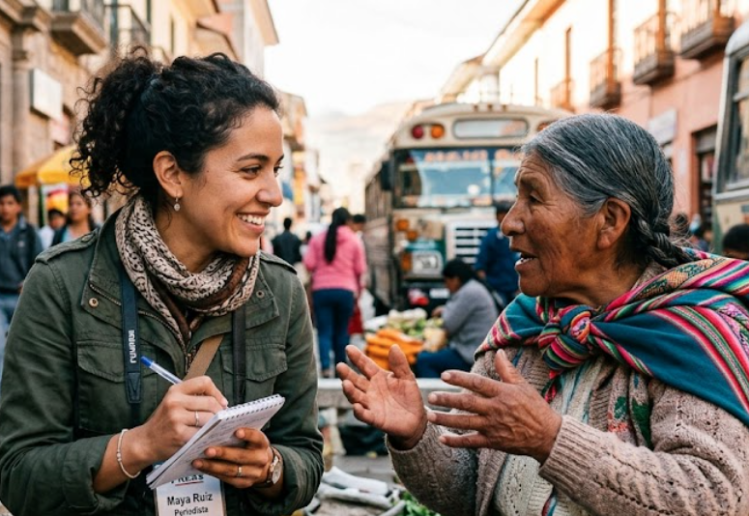
The clearest boundary journalists drew wasn’t technical — it was territorial. Artificial intelligence can process documents, generate drafts, summarize interviews, and optimize headlines for search engines. But it can’t go out and find things. It can’t call a source who refuses to talk through official channels. It can’t pick up on what’s left unsaid in a meeting room or an off-the-record conversation.
“I don’t see how an AI can get information the same way a human can. What audiences really value often comes from an off-the-record chat with a source — the kind an algorithm will never get,” said a senior journalist at Clarín. The distinction is key: it’s not that AI can’t write, it’s that it can’t access the information that matters.
The same logic applies to any serious communication strategy. The real insight — the one that reshapes a campaign, that identifies what an audience genuinely cares about — doesn’t come from any generative model. It comes from listening, observing, and asking. From being present.
Editorial Judgment: what the machine can’t decide
Another sharp limit that emerged from the interviews was judgment. “Editorial criteria — that prior knowledge — is what lets you use all these tools more effectively,” explained Juan Simó, editor at La Nación. This flips the logic of fear: professional experience and judgment don’t become less necessary with AI. They become more necessary.
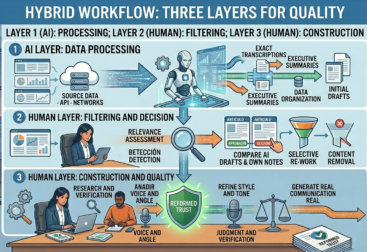
Why? Because someone has to decide what to do with what the model generates. What’s useful and what isn’t. What voice makes sense for this audience, at this moment, with this goal. AI produces volume. Judgment produces relevance.
The Byline: your most fragile and most valuable asset
In an era of fake news and algorithmic disinformation, the byline matters more than ever. “One of the most important assets of the outlet you work for — and of your own name — is the reputation and trust the audience places in you,” noted the same journalist. That capital is built through years of craft: verifying, making mistakes, correcting them, publishing.
AI has no byline. It takes on no responsibility. It risks no credibility. You do. And in an ecosystem saturated with content that has no clear authorship, that is precisely your differentiator.
So what do you do with all this?
Identify which parts of your work are genuinely yours — the judgment, the sources, the voice, the perspective — and protect them. Not from AI, but from the temptation to hand exactly those things over to it.
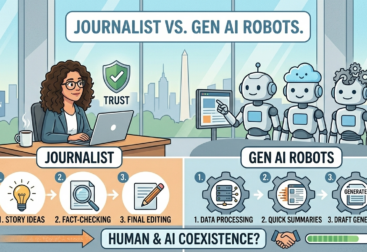
Use AI for mechanical tasks: transcription, summaries, first drafts, data formatting. Keep for yourself what no model can do: the analysis, the angle, the question no one has asked yet.
*Image credit: Created with Nano Banana.