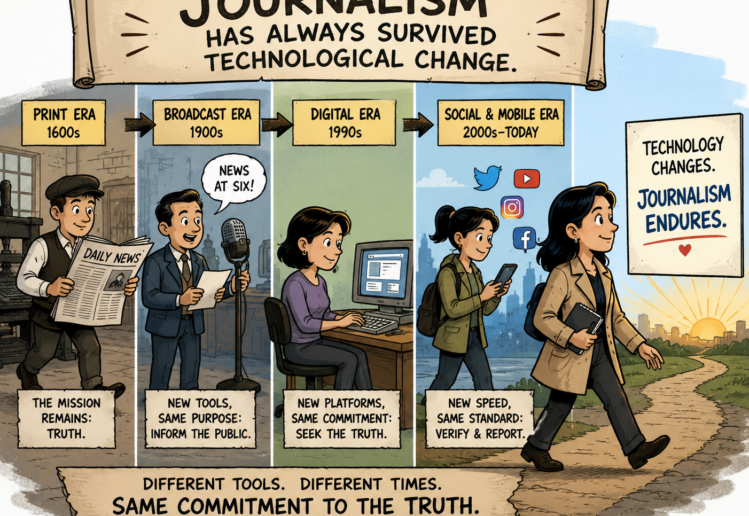
Every time a new technology appeared, people said journalism would die. Every time, it survived — transformed, but alive. Generative AI poses the same question, but with one difference that changes everything.
Argentine journalism was born as many other media in the world, from politic interest. The first newspaper on record, the Telégrafo Mercantil (1801), was championed by Manuel Belgrano. Mariano Moreno’s Gazeta de Buenos Ayres blended freedom of expression with government propaganda. Journalism was an elite practice: lawyers, politicians, and intellectuals who saw the press as a tool for building citizenship — or consolidating power.
From those origins to today, Argentine journalism has navigated the expansion of literacy, the media concentration of the 1930s, dictatorships and their censorship, the arrival of television, the internet explosion of the 90s, social media in the 2000s, and the digital subscription model of the 2010s. At each one of those ruptures, the same question was asked: does journalism survive this?
This content is derived from my master’s thesis, “Between the Human and the Automatic: Generative AI and the Role of Journalism as a Cultural Mediator” (2026).
The logic of the media ecosystem
One of the theoretical tools I used in my research is media ecology: the idea that media function like species in an ecosystem. When a new species appears — a new technology — it doesn’t automatically eliminate the previous ones: it forces them to adapt, find a new niche, specialize.
Radio didn’t kill newspapers. Television didn’t kill radio. The internet killed neither — though it profoundly transformed their business models and routines. Each new technology enters the ecosystem simulating the ones before it (the first news websites were essentially newspapers on a screen), and over time finds its own language.
Generative AI is in that first phase: it simulates, combines, produces content that looks like journalism but doesn’t yet have its own language.
What makes gen AI different
The difference that sets AI apart from every previous technological revolution is that it intervenes in the very core of journalistic work: the production of meaning. The printing press changed how information was distributed. Radio and television changed the medium. The internet changed speed and reach. Generative AI changes who — or what — produces the content.
The telegraph couldn’t write a news story. A TV camera couldn’t conduct an interview. AI can generate texts that, in many cases, are indistinguishable from those produced by a journalist. That’s not a difference of degree — it’s a difference of nature.
But what has always happened?
What history shows is that every time a technology threatened to replace the journalist, what survived was the function: the social need for someone to verify, contextualize, narrate, and make sense of events. The medium changed. The role, not entirely.
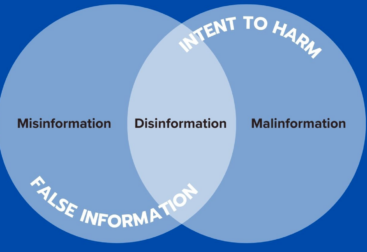
If that function is still necessary — and all evidence suggests it is, especially in an ecosystem saturated with disinformation — journalism will survive AI too. But as it has every time before: transformed. And those who don’t transform with it will be left behind.
Understanding the history of how media have transformed is part of how I think about strategic communication. If you want a long-term perspective for your organization, let’s talk.
*Image credit: created with ChatGPT