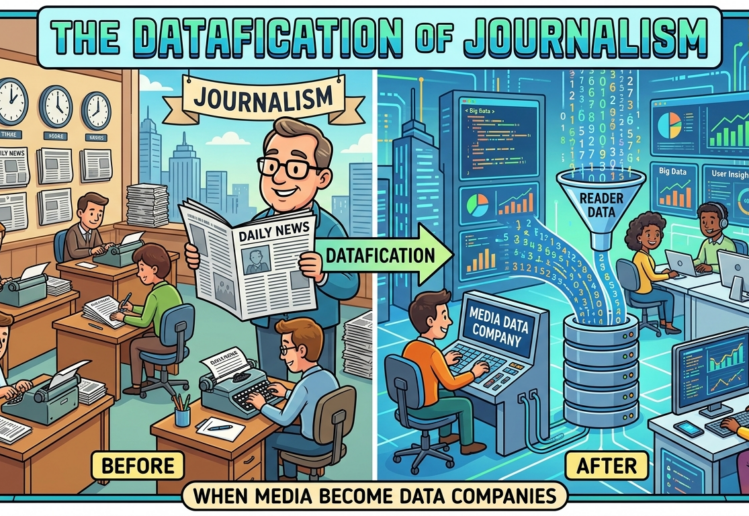
Clarín, La Nación, and Infobae no longer define themselves solely as journalism companies. They are redefining themselves as data and technology companies. That identity shift has consequences that go far beyond corporate rebranding.
One of the most significant findings of my research (my master thesis “Between the Human and the Automatic: Generative AI and the Role of Journalism as a Cultural Mediator”, 2026) wasn’t about what journalists said, but about what no one — neither the institutions nor their journalists — dared to openly ask: is the technological identity these outlets are adopting compatible with the democratic role they continue to claim?
The three outlets I studied — Clarín, La Nación, and Infobae — have developed their own AI tools (UalterAI, Genie, and ScribNews, respectively) and have begun publicly presenting themselves as actors in the data ecosystem, not just the information ecosystem. That’s not just a discourse update: it’s an identity transformation.
From press to data: the silent mutation
The datafication of journalism didn’t start with AI. It started when digital media began measuring clicks, optimizing headlines for Google, and personalizing content based on user behavior. Generative AI is the acceleration of that process, not its origin.
What changes with the explicit redefinition as a “data company” is the center of gravity. A journalism company produces content to inform citizens. A data company produces content (among other things) to understand and model user behavior. The citizen and the user are the same person, but the relationship the outlet establishes with them is qualitatively different.
The gap between what outlets say and what journalists defend
The most revealing silence I found in my integrated analysis was this: the three outlets have discursively redefined themselves as data and technology companies, but their journalists continue building their identity around categories drawn from traditional journalism: instinct, the street, the byline, verification.
Nobody asks whether those two identities are compatible. The institutional discourse doesn’t question whether the technological identity is compatible with the democratic role it claims. The journalists’ discourse doesn’t ask whether the skills they’re defending have a place in a data company. Those absent questions are, in my reading, the most urgent ones for understanding where journalism is headed.
What gets lost (and what gets gained)
On the loss side: authorship is diluted when content circulates as training data for AI models. The cultural mediator function is strained when platform logic overrides editorial logic. Informational diversity narrows when all outlets use the same models and produce convergent content.
On the gain side: personalization capacity, new ways of reaching audiences, tools for data journalism at scale, more sustainable business models through intelligent subscription systems. The transformation isn’t only loss.
A question that goes beyond journalism
This tension — between the logic of data and the logic of meaning — isn’t exclusive to media. It affects every organization that communicates in digital environments: brands, institutions, civil society organizations. The question is always the same: are you using data to better understand people and communicate something that matters to them, or are you using people to produce data?
The answer to that question defines not just your communication strategy, but what kind of institution — or brand, or professional — you want to be.
If you want to think strategically about your organization’s communication in this ecosystem — combining a journalistic perspective, audience research, and content design — this is exactly what I do.
*Image credit: created with Nano Banana