Generative AI is entering a journalism field that was already in a credibility crisis. Automating content doesn’t solve the problem. It can make it worse.
Before asking what AI does to journalism, we should ask what state journalism was in when AI arrived. The answer, documented in my research (my master’s thesis, “Between the Human and the Automatic: Generative AI and the Role of Journalism as a Cultural Mediator”, 2026) and in dozens of international reports, is: in crisis.
A business model crisis, yes. But above all, a trust crisis. A Reuters Institute (2024) study found that most news consumers worldwide trust media outlets little or not at all. In Argentina, that dynamic combines with political polarization, information overload, and what philosopher Byung-Chul Han calls “infocracia” — a regime where the excess of information weakens the capacity for public deliberation.
gen AI arrives on already eroded ground
The problem isn’t that AI is bad for journalism. It’s that it arrives on terrain where credibility is already eroded — where audiences no longer know which sources to believe. In that context, automating content without clear human oversight, without transparency about the process, without a responsible byline, aggravates exactly what journalism needs to repair.
“Journalism is the last place where you can trust that what is true, is true,” said a journalist at La Nación. He added that media are “the actor with authority to confirm.” That authority is neither automatic nor permanent. It’s built with every piece published and can be destroyed with every unacknowledged mistake.
In the interviews I conducted for my thesis, verification was the value journalists mentioned most. Not speed, not efficiency, not innovation: verification. “Someone has to check the information online,” they repeated in different ways across all three outlets.
This isn’t a guild quirk. It’s a response to a real need: in an ecosystem where any social media account can distribute content that looks like journalism, professional verification is what differentiates information from noise. And it’s what justifies, in the eyes of audiences, the existence of professional media.
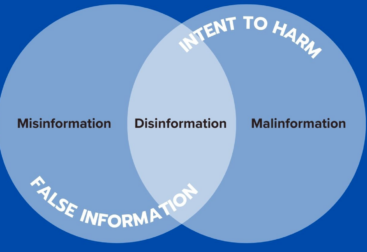
Philosopher Luciano Floridi argues that information, to be information, must be true. Everything else — misinformation through error, intentional disinformation — is not information: it’s noise in the shape of information. The role of professional communicators is precisely that: producing real, verified, responsible information.
The trust crisis is not only a media problem. It affects any organization or individual who communicates publicly. In a world saturated with automated content, credibility becomes the scarcest and most valuable asset.
Building it requires what AI alone can’t provide: consistency, accountability, transparency, and the willingness to verify before publishing. Not as bureaucratic red tape, but as a commitment to the people who read you.
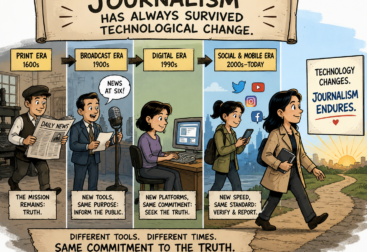
*Image credit: created with Nano Banana