For my master’s thesis, I interviewed journalists at Clarín, La Nación, and Infobae about how they’re experiencing the integration of generative AI into their newsrooms. What I found was more complex — and more honest — than any official position.
When a tech company presents a new AI tool for newsrooms, the pitch is always the same: efficiency, innovation, new possibilities. When you ask the journalists who actually have to work with that tool, the picture looks different.
This content is derived from my master’s thesis, “Between the Human and the Automatic: Generative AI and the Role of Journalism as a Cultural Mediator” (Master’s in Communication, Culture and Media Discourses, 2026).
One of the central findings of my research was what I called the dual discursive construction: journalists at Argentina’s three most-read outlets simultaneously build a narrative about AI that is both enthusiastic and defensive. That ambivalence isn’t incoherence — it’s a survival strategy.
gen AI as ally: the efficiency narrative
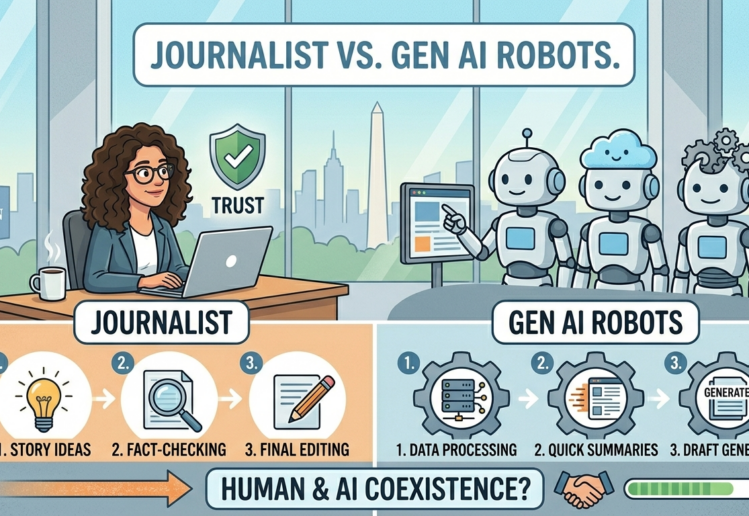
Most interviewees value AI for specific tasks: transcription, summarizing lengthy documents, headline optimization. The most repeated metaphor at La Nación is “assistant”; at Infobae, “editorial partner.” Both are significant: the first implies subordination, the second implies peer collaboration.
“As long as it’s a help, it’s fine,” summed up a journalist at La Nación. That sentence captures the dominant frame: AI is welcome as long as journalists assign it its role.
gen AI as threat: the fear few admit out loud
But beneath that open-minded discourse, a concern surfaces in nearly every interview: job replacement. “I’m a little scared they’ll say: journalists are useless now,” this journalist admitted. “I think it’s going to wipe out a lot of journalists. I’d love to think it won’t, but I believe it will,” said one Infobae reporter.
The threat, however, gets bounded discursively: it won’t be a total replacement, only of the most routine tasks. And it will only affect those who can’t use the tools effectively. This framing serves a psychological and rhetorical function: it allows journalists to adopt the technology without feeling like they’ve surrendered.
What the discourse reveals — and what it hides
The tension between the two poles — ally and threat — doesn’t get resolved in the interviews. It coexists. And that coexistence is itself a finding: it shows that the Argentine journalism field is in a still-open process of identity negotiation.
Most revealing, perhaps, is what the discourse silences. Not one interviewee mentioned unions or collective bargaining structures. Nobody discussed whether the extreme speed AI imposes is compatible with the verification standards everyone claims to uphold. And audiences — the people who actually read — don’t appear with their own voice in either corpus.
What Argentine journalists say about gen AI is not just a description of their work: it’s a declaration of principles about what they want journalism to be. And in a moment when that definition is more contested than ever, that matters more than it might seem.
*Image credit: Created with Nano Banana.