There’s a capacity that connects the street journalist with the UX researcher: the ability to read what’s left unsaid. It’s trained intuition. And it’s exactly what no algorithm can replace.
When the journalists I interviewed for my thesis (“Between the Human and the Automatic: Generative AI and the Role of Journalism as a Cultural Mediator”, 2026) described what artificial intelligence can’t do, one word kept coming up: instinct. Journalistic instinct. That hard-to-define, impossible-to-ignore capacity that distinguishes a great reporter from someone who simply writes well.
As I analyzed their answers, I kept thinking about another discipline I know well: UX research. And about how that same capacity — reading what isn’t in the data, listening to what an interviewee isn’t saying explicitly — is exactly what distinguishes a good user researcher from someone who just tallies responses.
What journalistic instinct really means
A deputy editor at Clarín prefers not to call it instinct. He calls it “ingenuity” and “the ability to look for something different.” For an editor at La Nación, it’s “editorial judgment — that prior knowledge that lets you use all these tools more effectively.”
One Infobae reporter defined it from a generational perspective I find especially illuminating: “There’s a difference between the critical eye of someone who did the artisanal work of finding a source, structuring an article, choosing the best quote from an interview — and someone who started by feeding everything to a chat.” Instinct, in her account, is built by hand. It can’t be bought or automated.
The parallel with UX Research
In UX research, the analogous distinction is between someone who listens to answers and someone who listens to people. Survey data tells you what users said. A well-conducted interview tells you why they do things, what they won’t say directly, what contradiction exists between what they claim and what they actually do.
That gap — between what people say and what they do — is the territory where real insight lives. And finding it requires exactly what good journalism requires: presence, active listening, genuine curiosity, and the ability to follow an unexpected thread when it appears, even if it wasn’t in the script.
What the two disciplines share
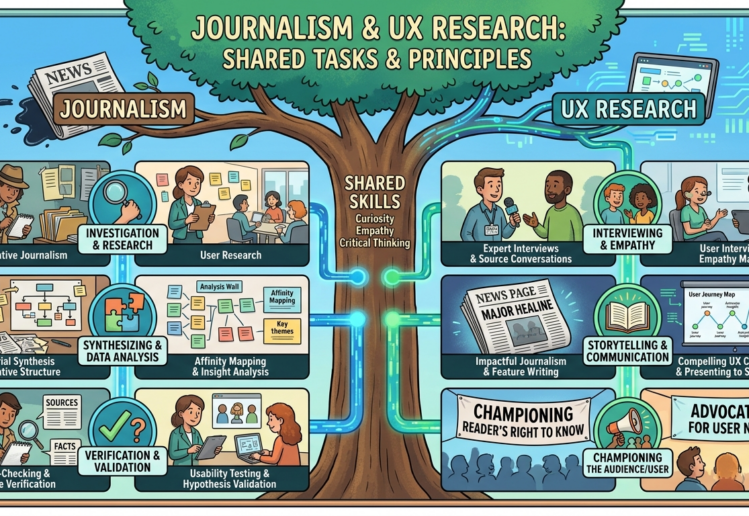
Both journalism and UX research are, at their core, practices of human understanding. Both seek to understand what people think, feel, and need. Both work with sources who don’t always say what they mean. Both produce knowledge that didn’t exist before someone went out to find it.
And both face the same risk in the AI era: the temptation to replace the artisanal fieldwork with automated outputs that look like knowledge but are, at best, a synthesis of what was already known.
Why this matters for your communication
If you want to communicate something that genuinely connects with your audience — whether that’s an article, a campaign, a value proposition, or an interface — you need to understand those people for real. Not what a language model predicts they’d say. What they actually think, feel, and need.
That requires going out to find it. Asking. Listening. Following the thread even when it wasn’t in the plan. It’s instinct, essentially. Call it what you want.
*Image credit: created with Nano Banana